June 5, 2026
The Hidden Factory: Why the Average Plant Runs at 60 Percent OEE
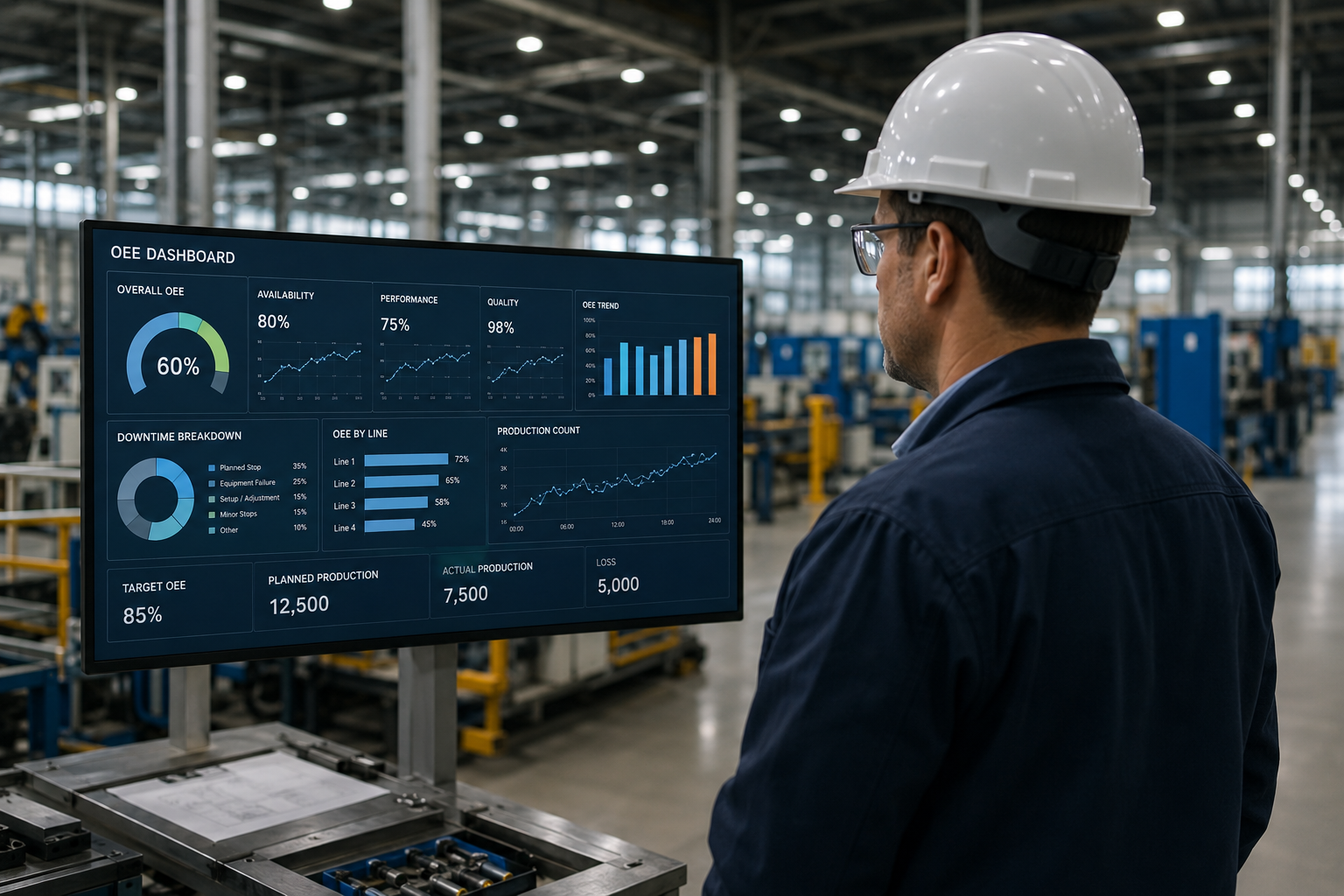
Here is the number that should keep every plant manager up at night. World-class manufacturers run at 85 percent Overall Equipment Effectiveness or higher, but the average discrete manufacturer sits between 55 and 67 percent. That gap is not abstract. It is a second factory, fully staffed and fully paid for, that you never ship from. We call it the hidden factory, and unlocking it is almost always cheaper and faster than buying new capacity.
What is a good OEE score?
Overall Equipment Effectiveness measures how much good product a line produces versus its theoretical maximum. It multiplies three factors: availability (is the equipment running when it should be), performance (is it running at rated speed), and quality (is it producing good parts the first time). The Japan Institute of Plant Maintenance set the world-class benchmark at 85 percent, a level only a small share of plants ever reach.
The reason most plants fall short is the multiplication itself. Three numbers that each look healthy combine into a result that does not. A line at 90 percent availability, 90 percent performance, and 90 percent quality scores just 73 percent OEE. Strong components, mediocre output. The losses hide in plain sight precisely because no single metric looks alarming.
How much capacity am I losing at 60 percent OEE?
A plant running at 60 percent against a realistic ceiling of 85 percent is leaving roughly a quarter of its productive capacity on the floor. On a line that anchors revenue, that can be the difference between turning away orders and funding the next phase of growth without a single dollar of capital expenditure. The capacity is already inside the building. It is trapped in unplanned downtime, slow cycles, changeover time, and quality escapes that force rework.
Industry data shows wide variation by sector. Medical device manufacturing averages around 78 percent, near the top of the range, while trailer and recreational vehicle production sits closer to 57 percent. The point is not the absolute number for your industry. The point is the gap between where you run today and where a disciplined operation runs, because that gap is recoverable margin.
Why measurement comes before capital
Most plants do not have an honest, real-time view of OEE. They have shift reports, tribal knowledge, and a sense that things could be better. Without trustworthy measurement, capital decisions get made on instinct, and the easy answer is always to buy more equipment. That is the most expensive way to solve a problem you have not diagnosed.
The first move is to install real-time OEE measurement on the constraint equipment and let the data name the single largest loss bucket. In most plants it is changeover time or unplanned downtime, not raw machine speed. Once the biggest loss is visible, a focused team can attack it with structured problem solving, quick-changeover methods, and tighter preventive maintenance. The capacity returns in weeks, not quarters.
What a 90-day throughput sprint looks like
A Throughput Acceleration Sprint targets the bottleneck that most limits output. The first two weeks establish honest OEE measurement and quantify the prize. The middle of the sprint deploys operators alongside your team to eliminate the top loss drivers and to install the daily management routines that hold the gains. The final stretch embeds the performance discipline so the improvement survives after the sprint ends.
Done well, a single sprint frees more capacity than a year of capital spending, improves on-time delivery, and lowers cost per unit. It also gives leadership something rare: a defensible, data-backed view of whether new capital is actually required, or whether the capacity was there all along.
Key takeaways
• World-class OEE is 85 percent or higher; the average discrete plant runs 55 to 67 percent.
• OEE multiplies availability, performance, and quality, so three 90 percent factors yield only 73 percent.
• A plant at 60 percent OEE is leaving roughly a quarter of its capacity unshipped.
• Install honest measurement first, then attack the single largest loss before approving capital.
• A focused 90-day sprint typically frees more capacity than a year of new equipment spend.
Unlock the plant you already own
Before your next capital request, find out how much of the answer is already inside your four walls. Quadrillion deploys operators who have run plants, not analysts who have studied them, to measure the hidden factory and convert it into shippable output. The fastest capacity you will ever buy is the capacity you already pay for.
About Quadrillion Partners
Quadrillion Partners is an operator-led performance improvement firm. We deploy former CxO operators to deliver measurable EBITDA, cash, and enterprise value in 90 days, not 18 months. More than $1.2 billion in enterprise value delivered since 2012.
Plan. Operating, strategic, and value creation plans built by operators who have owned the AOP. In market in 60 to 90 days, ready for the board, sponsors, and lenders.
Execute. 90 to 180 day sprints against the single constraint limiting performance: digital and AI, go-to-market, throughput, or working capital. Success fees aligned to the EBITDA we deliver.
Embed. Interim CFO, CTO, Chief Transformation Officer, and FP&A leadership through the inflection: pre-sale prep, post-close integration, or a leadership gap. We hire your permanent successor before we step out.
Contact George Stelling, Managing Partner and CEO
Email: gstelling@quadrillionpartners.com | Phone: +1 650 678 1887
Web: www.quadrillionpartners.com