An organization that needs to transform is a lot like a house with leaky pipes. It still works, but nobody wants to open the walls.
Most of the companies I’ve worked with over the last 30+ years grew by muscling through their problems. They patched one leak and then another, made a local fix here and a workaround there, and leaned on talented people to cover for a system that stopped making sense a long time ago. Good people are very good at this, and as a result, the problem is often hidden.
That approach can work for years. When it finally gives, the leadership team is suddenly making decisions under pressure instead of by choice.
More than 130 projects on one list
For instance, a board member introduced us to the new CEO of a $1.4 billion private-equity-owned technology company. Before we opened any walls, we asked the leadership team for a list of every project underway.
We received 15 emails with spreadsheets attached. One executive forwarded 10 separate threads.
We combined everything into one list with owners, team members, and financials where available. The total came to more than 130 active projects.
The CEO said the list was wrong. As we went through it line by line with the management team, it became clear that the list was right, and probably understated. He looked at his team and said, “This is why we brought these guys in.”
The worst leak was in the CRM
The worst leak was two groups making changes to the CRM platform at cross purposes. If both had finished, the sales team would not have known how to book or manage an opportunity. (Opportunity management and the systems roadmap were both run by hand, and nobody could say what the 130 projects added up to.)
The leaks had been hidden inside the walls while they were still small. By the time it became visible, the company had to make sense of overlapping work, unclear ownership, and investments that could not be evaluated as a portfolio.
Treat transformation as a set of bets
The better path is to outrun the chaos. That starts with treating transformation as a set of deliberate bets, not a pile of improvement projects.
A bet might be new technology, a new market, redesigned operations, or a different business model. Each one is an investment the company expects to pay back.
Those bets come in different sizes. Some pursue breakthrough impact and carry more risk.
Others are smaller, safer, and build momentum over time. I think about them the way a manager builds a baseball lineup: you want to be able to produce some home runs, but most of your wins come from singles and doubles.
Similarly, most organizations know they need to change, and many even know roughly which direction to go. What they lack is a reliable way to decide which ideas deserve capital and which problems are only symptoms of something deeper.
Decipher first, then deliver
I built the Decipher & Deliver process to close that gap.
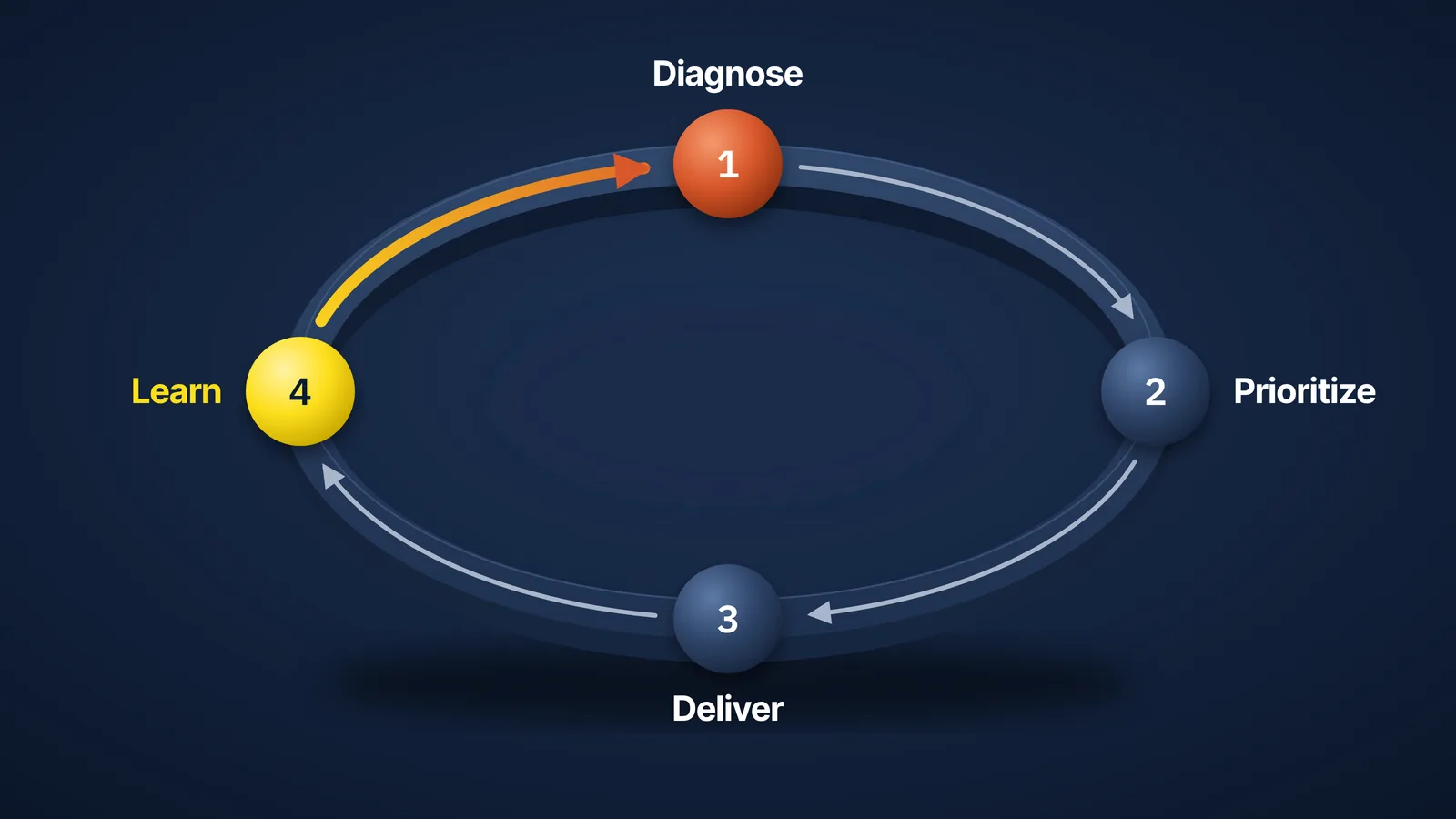
First, Decipher. Open the walls and find out what is actually leaking before funding a fix. Bring out what the organization already knows but has not said out loud, then test each idea hard enough that only the strong ones survive.
Then, Deliver. Turn what you learned into a short list of bets, assign people who have real time to do the work, report progress honestly, and establish enough governance to adjust before a problem becomes a crisis.
At the technology company, 35 projects survived the cut. We grouped them into eight super projects by theme, which made the work easier to communicate across the company.
Each one had an owner and clear objectives, without overlap. Outside consulting spend fell approximately 25% after we removed duplicate work and phased the rest.
The company gained more than the savings. I call it the Operator’s Edge, the payoff to executing Decipher & Deliver in the right order.
Decision quality
You know which ideas and bets deserve capital before the money moves instead of finding out during rollout.
Execution velocity
The time from decision to result gets shorter because every project has one owner with the time and authority to do the work. At the technology company, everyone knew who owned each project and what it was meant to deliver, so there were no surprises.
Compounding learning
Each cycle teaches the organization something about how to make the next decision. It gets better at choosing bets every time it goes through the process.
Decipher & Deliver: Removing Friction Points in Business and Digital Transformations is available now at decipheranddeliver.com.